A property management firm in Monterrey, Mexico was running 30 mixed-use properties with a 3-person team and a patchwork of disconnected tools. When they implemented monday.com, they uncovered two uninsured properties and three vehicles with expired coverage within the first weeks, and recovered 20 hours per week in operational overhead.
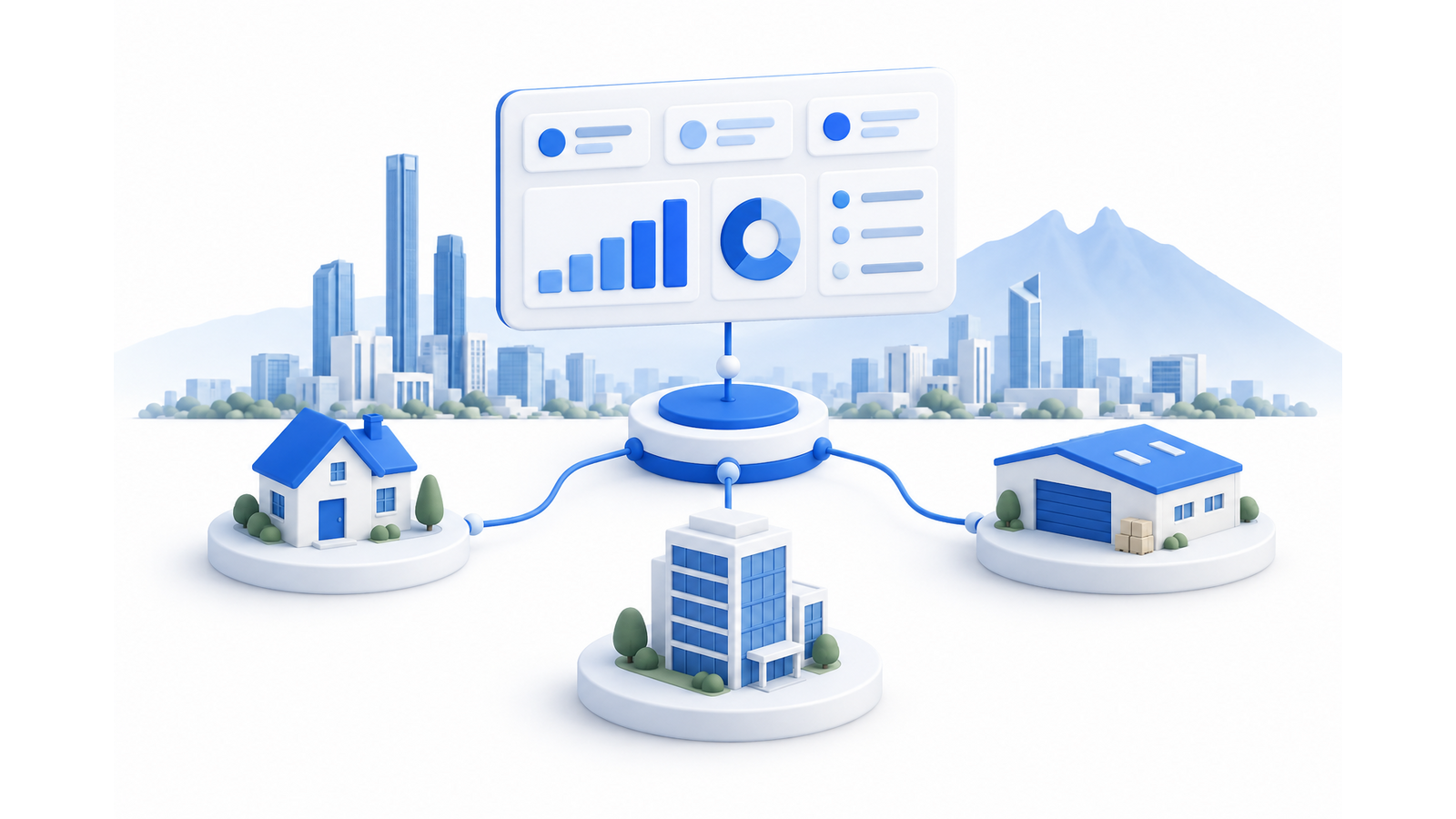
Running a property management company looks manageable from the outside. You collect rent, coordinate maintenance, and keep property owners informed. In practice, it is one of the most operationally demanding small businesses you can run. Dozens of properties, dozens of vendors, dozens of dates that cannot be missed, and a team small enough that one dropped ball affects everyone.
When we first sat down with this client, a mid-sized property management firm in Monterrey, Nuevo Leon, Mexico, that reality was on full display. Around 30 properties across residential, commercial, and warehouse segments. A team of three employees, plus a rotating cast of contractors and vendors. And a collection of tools, including Excel spreadsheets, Dropbox folders, email and WhatsApp threads, and a separate software for tracking property specs and rates, each doing their job in complete isolation from the others.
Nothing was catastrophically broken. But a lot of things were quietly slipping through the cracks, and the team knew it.
This was not a team that lacked experience or effort. They were sharp, committed, and knew their business well. The problem was structural: every piece of information lived in a different place, and there was no reliable system connecting any of it.
Property details and pricing lived in one dedicated software. Lease dates and payment tracking lived in Excel. Documents were scattered across Dropbox. Communication happened over email and WhatsApp. And the processes for onboarding a new property, handling a maintenance request, or managing a renewal? Those were not written down anywhere. They existed in people's heads.
When everyone is in the office and nothing unusual is happening, that kind of setup can hold together. But it does not take much to expose the gaps.
Two properties were operating without current insurance coverage. Three company vehicles had expired insurance. Nobody had caught it because there was no system watching for it. The information existed somewhere, buried in a spreadsheet or an old email, but it was not visible to anyone in a way that would actually trigger action.
Renewal dates, payment deadlines, and registration expirations were tracked manually. When someone was busy or out, the checks did not happen. Things passed their deadlines without anyone noticing until it was too late.
The team estimated that they were spending 15 to 20 hours a week on coordination, follow-up, and chasing down information. But more than the time, it was the uncertainty that wore on them. The constant background feeling that something important might be slipping through, with no easy way to know what or when.
The owner knew something had to change. There was no single incident that forced the issue, just a growing recognition that the operation was becoming harder to manage as the portfolio grew, and that the team deserved better tools. He came to us looking for a solution, and we started where we always do: understanding the business before recommending anything.
Through our software selection process, we evaluated the options against what this business actually needed. They were not looking for a traditional property management platform. They already had software for property details. What was missing was a system that could connect everything else: the processes, the dates, the tasks, the people, and the communication.
Monday.com was the right fit. It was flexible enough to be configured around their actual workflows rather than forcing them to adapt to a rigid structure, and it could be rolled out gradually, one process at a time. For a small team that could not afford to stop everything for a full system migration, that mattered a lot.
We handled the implementation over 2 months, and we were intentional about the pace. Rather than trying to move everything at once, we rolled out one process at a time, testing and validating each piece before moving to the next. That approach kept the team from getting overwhelmed and gave each new workflow a chance to actually stick.
We started with the basics: a master list of all their properties and company vehicles, then boards to track insurance, registration, and taxes across the portfolio. That first step alone was revealing. The two uninsured properties and the three vehicles with expired insurance showed up immediately once everything was in one place and visible. It was a quick reminder of why the project mattered.
From there, we built out a client list and tackled the core operational processes one by one: lease renewals, property onboarding, property offboarding, and new tenant applications.
The team was cooperative and genuinely enthusiastic throughout. There was no resistance to the change, which made a real difference. The bigger challenge was that not all the information was readily available. It took time to gather and enter the data needed to populate the boards fully, and because the company's processes were more complex than they might appear from the outside, training took longer than expected. The staged approach helped absorb that. Each rollout was small enough to work through without overwhelming anyone.
We also connected Monday.com to email, Google Calendar, and Google Drive, which brought their existing tools into the same workflow rather than replacing them entirely. The goal was never to rip everything out. It was to make what they already had actually work together.
Today, the business runs through a set of connected boards that cover every major area of operations. Here is what that looks like in practice.
Every property in the portfolio has an entry with its key details, current status, and upcoming dates. Insurance expirations, registration renewals, and tax deadlines are tracked with automated alerts so nothing approaches a deadline without someone being notified in advance. The same applies to company vehicles. This was the area where the value showed up fastest. Within the first weeks, the team had already identified and resolved the compliance gaps that had been invisible before.
That kind of visibility had simply not existed with spreadsheets.
Each major workflow now follows a defined process with clear steps, assigned owners, and tracked progress. Property onboarding, offboarding, lease renewals, new tenant applications: all of it runs through the system. When a renewal is coming up, the process starts automatically. When a property is being onboarded, every step from documentation to setup is visible in one place. Deadlines no longer pass unnoticed.
Maintenance requests are tracked from submission through completion, and vendors and contractors are managed in a dedicated board with their contact information, service categories, and relevant documentation. The coordination that used to happen through scattered email threads now has a home.
As the team grew more comfortable with the platform, they expanded into more complex territory. We built a purchase order process with multi-level authorization based on the amount involved, including a quoting workflow that collects bids from multiple vendors before approval. Once a purchase order is approved and the work is completed, a workflow generates the invoice and tracks payment through to completion.
That was not part of the original scope. It grew out of the team's confidence in the system and their recognition that the same approach could be applied to other parts of the business. That kind of organic expansion is one of the best signs that an implementation has actually taken hold.
The most concrete outcomes showed up right away. Two properties that were not insured got covered. Three vehicles with expired insurance were renewed. Those were not small issues. They represented real liability exposure that had been invisible until the system made it visible, and they were resolved within the first weeks of going live.
Over time, the operational improvements compounded. The team recovered an estimated 20 hours per week that had been going to coordination, follow-up, and manual tracking. Renewal processes now run on schedule. The owner has real-time visibility into the portfolio without having to ask anyone for a status update.
But the most significant change was harder to put a number on. The team stopped operating in reactive mode. When something needed attention, the system surfaced it before it became a problem. The uncertainty that had been a constant background condition of the business largely went away, and that shift in how the team experienced their work every day is not something that shows up in a metric.
This client's experience is not unusual. Most property management operations at this scale are running on some version of the same setup: a mix of spreadsheets, email, shared folders, and individual memory holding everything together. It works until it does not.
What we helped them build was not a replacement for those tools. It was a layer that connected them, made information visible, made processes consistent, and made accountability clear. The team did not get bigger. The portfolio did not get simpler. But the operation became manageable in a way it had not been before.
For companies managing a similar mix of properties, vendors, and compliance requirements, the question worth asking is not whether your current tools are capable. It is whether the information they hold is visible to the right people at the right time. In most cases, the answer is that it is not, and the cost of that invisibility is higher than it appears.
Whether you're managing projects, streamlining workflows, or collaborating with your team, monday.com can help you turn plans into progress.